Learning Modalities & Requirements
Positive Psychology education thrives on interaction, reflection, and applied learning. To ensure quality and consistency across accredited programs, the following learning modalities are defined and regulated. These standards apply to all programs seeking accreditation and must be transparently documented in application materials.
-
(Live, Real-Time, Not Always Co-Located)
Definition:
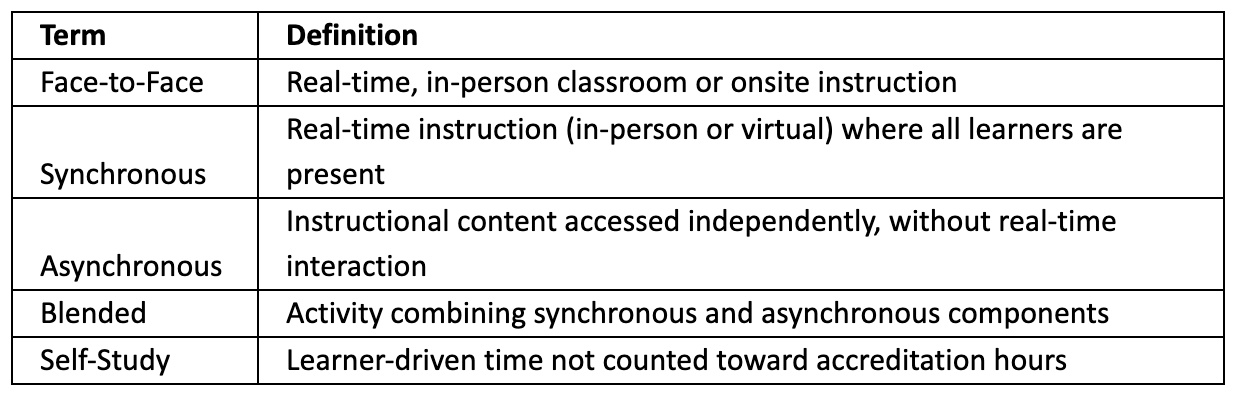
Synchronous learning reflects instruction where all participants are engaged at the same time, though not necessarily in the same place. It includes both in-person and virtual formats such as web conferencing, live video lectures, and virtual breakouts (Kumar & Eisenberg, 2023; Parslow, 2012).
Recommended Formats:
· Live video conferencing (Zoom, MS Teams)
· Instructor-led virtual group sessions
· Supervised consultations or peer activities in real-time
· Instructor- or TA-led breakout rooms
· Live virtual case studies or simulations
Key Features:
· Real-time dialogue and feedback
· Higher learner accountability and engagement
· Critical for interactive and supervision-intensive modules
-
(Non-Live, Self-Paced Instruction)
Definition:
Asynchronous learning involves instructional content and activities accessed independently, without real-time interaction. Learners proceed at their own pace, typically through pre-recorded lectures or digital tasks (Kumar & Eisenberg, 2023).
Recommended Formats:
· Pre-recorded instructional videos
· Interactive modules with embedded tasks
· Instructor-reviewed reflections, journals, or quizzes
Key Guidelines:
· No more than 25% of total instructional hours may be asynchronous
· Only instructional video/audio durations count toward asynchronous hours
· Self-paced tasks (e.g., readings, forum posts) do not count unless tied to instructional content
· All asynchronous components must include:
· Structured learning objectives
· Alignment with assessments
· Feedback mechanisms (even if delayed)
Note: Asynchronous learning—of any type—must not exceed 25% of total learning hours across all levels, from Foundational through Level 4. -
(Independent, Non-Instructed Learning Time)
Definition:
Self-study refers to time learners spend independently preparing for or reinforcing formal instruction. It includes non-assessed, non-facilitated learning tasks.
Examples Include:
· Reading assigned materials
· Journaling or writing assignments
· Practicing tools in real-life contexts
· Independent literature review
Guidelines:
· Self-study hours are excluded from required accreditation hours
· May be referenced in curriculum overviews but not counted toward credit
-
(Independent, Non-Instructed Learning Time)
Definition:
Blended learning combines asynchronous preparation with synchronous or face-to-face engagement to deepen understanding.
Examples Include:
· Watching a video module followed by a live seminar
· Reading a case study in advance of a peer dialogue
· Completing a pre-class quiz used in a real-time debrief
Requirements:
· Programs must clearly distinguish synchronous vs. asynchronous components
· Blended activities must be purposefully integrated to support learning outcomes

Peer Learning and Group Participation
Clarification:
Peer learning (e.g., study circles, collaborative projects) is a co-curricular component and does not count as formal instructional time unless led or supervised by a qualified facilitator.
Policy:
Mandatory at Level 2 and above
Must be structured and aligned with program objectives
Cannot replace instructor-led learning
Instructional Time Reporting
Programs must clearly document instructional time by modality:
Face-to-Face (in-person)
Synchronous (live, real-time online or in-person)
Asynchronous (pre-recorded, non-live content only)
Self-Study (excluded from required hours)
Blended (must show breakdown of live vs. recorded)
Note:
Synchronous (live) instruction—whether in person or online—must dominate the delivery model across Levels 1 to 4.
Assessment Across Modalities
Programs must detail evaluation strategies across modalities, including:
Quizzes or reflections tied to asynchronous content
Active participation in synchronous or in-person sessions
Final applied projects or field-based assessments
Feedback loops (peer or instructor-led)
Refer to Standard 10: Program Evaluation for alignment expectations between content, delivery mode, and learning outcomes.